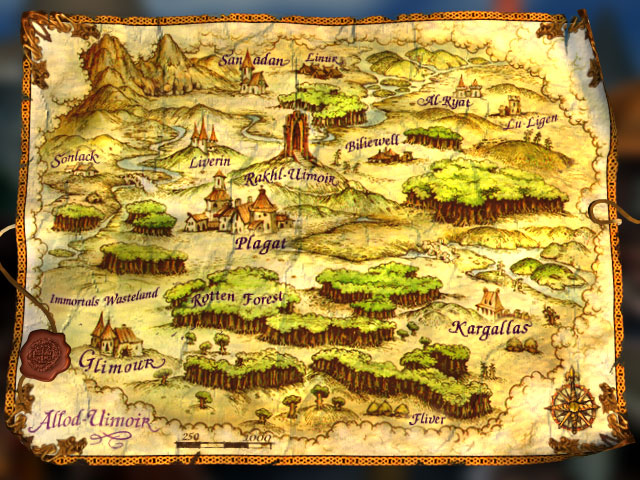
 You have confronted fearsome necromancers whose dark magic nearly transformed you into a soulless zombie. As you have undoubtedly noticed, the appearance of your hero has undergone irreversible changes. However, hope remains alive: deep within these lands, beyond treacherous forests, abandoned ruins, and gloomy dungeons, lies a powerful artifact capable of restoring your former visage…
During the midgame of Allods 2, you will explore mid-level maps. These areas are much more dangerous, but the rewards for defeating monsters are greater, and you gain experience faster. You will face level 2 and 3 monsters*. If you’ve made it this far, you can already be considered a true alloder.
*Monster Levels
The difficulty of monsters in Allods increases in leaps, with five levels of strength for each monster. If on the first and second server you are fighting level 1 enemies, on the third server, you’ll encounter levels 1 and 2, and on the fourth server — levels 2 and 3, and so on. Higher-level opponents have enhanced attributes and may even gain new magical abilities.
You can identify the level of monsters by the color of their skin, for example, “green” orcs are level 1, “red” are level 2, “blue” are level 3, and so on.
I moved to the second server… and lost my skills and items. Why?
Remember that when transitioning from one server to another, you undergo “Rebirth” — you lose all money and part of your experience; the mage loses all items and spells, while the warrior only keeps the equipped gear (any unequipped items in the bag disappear).
Tavern
On our server, equipment is not sold in shops (only potions, magic books, and scrolls are available there). Gear can only be obtained by completing quests or looting monsters.
If on server 1 you mainly dealt with the merchant’s shop, starting from server 2 you will spend a lot of time in the tavern. Here you can take quests which reward you with various pieces of equipment.
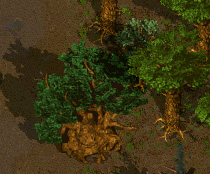
There are three types of taverns: medieval, desert (yellow houses), and druid. Their appearance may also vary slightly depending on the direction the building is facing.
You already know that killing enemies grants experience and gold. However, tavern quests do not grant experience. If the reward offered is an item you do not need, it is usually better to take gold, scrolls, or a helper.
Types of quests
Quests come in several types. The first type, and the simplest to complete, is “Kill n enemies”. The number of enemies in such quests is random, but you can use the quest filter (see below). If there are 8 monsters of a certain type on the map, you may receive a quest to kill up to 25 of them. It is important that those 8 monsters are present at that exact moment. For example, if there were originally 10 spirits on the map and you killed 3, only 7 remain; a quest for 25 will not appear until the killed enemies respawn. It is also worth noting that if there are more than 7 living monsters of this type on the map, it will not be possible to receive a quest for a small number of them, for example one.
You can display tavern quests for a specific monster. Use the command: #quest <monster> or #q <monster>. There are several additional commands; details can be found in the Quest Orders guide.
If you have just moved to a new server, one of the fastest ways to obtain starting equipment is to take quests for a small number of weak monsters. The quest order filter is useful for this. For example, you can request a quest for one squirrel with the command:
#q sq 1
After that, a quest to kill one squirrel will appear in the first tavern slot. These quests can be completed very quickly even by the weakest heroes, so you can do several of them in a row and obtain some starting rewards. The same principle can also be used when searching for specific items. Rewards depend on the amount of experience assigned to the quest, so by trying quests with different numbers of monsters you can increase the chance of receiving equipment for the slot you need.
Another useful quest type for beginners is monster intercepts. When you take such a quest, a raid on the city begins. Usually the enemies need some time to reach the city, since they start somewhere on the outskirts and only begin moving after the quest is taken. Your goal is to stop them before they get too close to the tavern. If the enemies reach the tavern, the quest fails and the attacking monsters will remain near the tavern until they are killed. If you defeat them before they reach the tavern, the quest is completed and you receive the reward. These quests usually have a long cooldown (the time before the quest becomes available again), so after completing all available intercepts it makes sense to do other types of quests as well.
City guards and other players can help you complete the quest, but for it to count the final enemy in the group must be killed by you (you must land the final hit).
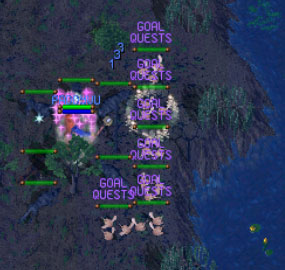
Another quest type is to kill a specific enemy. You must find the exact monster indicated in the quest. It can be identified by the inscription “Quest Goal” above its head.
The most difficult quest type is “Destroy an enemy group”. Completing it grants an additional reward. City guards and other players may assist you in combat, but for the quest to count the final enemy in the group must be killed by you.
Sometimes the desired quest must be rolled. Quest rolling means leaving the tavern and immediately entering again in order to obtain the quest you want (quests refresh when you re-enter). Different items “cost” different amounts of experience, so taking the quest with the maximum experience is not always the best option. Sometimes, to obtain the item you want, it is more effective to complete a lighter quest.
Each server has its own reward cap which determines the maximum possible reward. On the second server it is 8250, on the third 44750, and so on. You cannot receive a reward higher than the cap, even if the quest is very large. For example, killing one level 2 troll on the second server gives the same experience as killing three level 2 trolls; however on the third server even three trolls will not reach the maximum reward.
Tips from Experienced Players
- Remember that you can lure monsters into the city, where the guards can assist you in battle. They are hostile to monsters and are usually quite strong (there are knights hostile to the player, but not in the starting cities).
- It’s very effective to play as a mage-warrior duo; while the warrior tanks, the mage can heal him and attack weaker enemies with spells. To heal automatically, enable auto-casting with
Ctrl+a, which allows your character to use the spell on the correct target without any input from you. On our server, the healing distance is much shorter than in the regular game, so the warrior needs to protect the mage’s back. - A character’s health depends on their “Body” attribute and experience. Mana depends on “spirit” and experience. Vision depends on reaction and intellect. The speed of skill leveling depends on intellect. The damage of the mage’s spells depends on intellect and skill.
- The stats of monsters, such as attack and defense, that you see in the information window do not match their actual values. These stats can differ on each server, but there’s no way to change the numbers in the information window. For example, a goblin on the first server might have a defense of 20, but on the second server, it could be 30, yet the information window will show 20 in both cases. This also applies to spell attributes, some item stats, and other game elements.
- You already know that it’s not a good idea to log out of the game without camping or being in a town hall, otherwise, your character will remain on the map for another 5 minutes. However, sometimes this can be useful—if you’ve been killed and respawn in a dangerous location (an enemy town; intercept quest by monsters you can’t defeat, etc.)—you can exit the game using
Alt+F4and wait for 5 minutes. Keep in mind that the server will log you out after 5 minutes only if there are no attempts to log in under your account.
For the Warrior
- Since you’ll start with a zero main skill when transitioning to a new server, it’s best to prioritize light one-handed weapons with an “attack” bonus initially, so you can hit enemies more frequently. For example, choose a dagger (if you selected swords) or a light flail (if you selected maces), etc.
- You already know that defense helps you dodge attacks, while armor reduces the damage from them. Defense is especially effective in battles with ogres and trolls, who attack slowly but deal significant damage. Armor, on the other hand, is useful against goblins and animals that attack quickly, hit frequently, but deal less damage. And remember, magic, bat sonic waves, bee stings, and spider bites completely ignore all armor points!
- At the early stage, it’s not shameful for a warrior to use scrolls. They are VERY useful for a weak and poorly equipped warrior, as spells have no cooldown and reading scrolls doesn’t cost mana. A particularly useful scroll against dangerous enemies is the “Curse” scroll (use it on the enemy), which reduces the enemy’s physical damage to a minimum. The regular (non-elven) version of this scroll costs only 300 gold, but it allows you to fight very strong monsters like ogres and trolls. It’s also worth using it, for example, against dragons. Mages can’t use scrolls, but they can obtain a staff with the “Curse” spell (available on each map).
- Use not only regular healing scrolls for 50 gold, but also the elven version for 3,000; they heal much more effectively and allow you to defeat stronger enemies, giving you access to better equipment.
- Note that the casting speed of spells from scrolls depends on the type of weapon you have equipped. With a one-handed weapon, you can cast several scrolls in the same time it would take to cast them with a heavy two-handed weapon. Scrolls are especially slow to cast with a bow or crossbow in hand; therefore, if you’re fighting a flying enemy (like a dragon), it’s worth switching from a ranged weapon to a melee weapon using a hotkey to quickly heal with scrolls, and then switching back after healing.
- When fighting particularly strong enemies, it makes sense to use not only the “Curse” scroll but also scrolls that enhance your hero, such as “Blessing,” “Magic Shield,” “Haste,” and others.
For the Mage
- The same spell can cost different amounts of mana on different servers. For example, the “Summon” spell costs:
25 mana on the 1st server,
50 mana on the 2nd server,
100 mana on the 3rd server,
150 mana on the 4th server, and so on. - Mages should not overlook staves, as they attack much more frequently (faster) and do not require mana. But even if you find a powerful staff, it often still makes sense to cast spells “manually” with auto-casting (
Ctrl+a), as the range of a staff is usually shorter than that of spells from the spellbook. - Pay special attention to leveling up astral skills using the “Drain Life” spell. It’s best to find it on a staff. Some monsters are immune to astral magic (such as trolls, ogres, and dragons), but not all. This spell can effectively level up your “Astral” skill, which in turn strengthens important spells like “Heal,” “Magic Shield,” “Summon,” “Haste,” and others.
- Remember that you can summon multiple animals with “Summon,” but only one will stay permanently — the others will eventually disappear. Buffs work on summoned creatures. The maximum level for summoned beasts is 4, requiring 75 astral skill. However, even a first-level pet, in skilled hands, can kite very strong enemies (don’t forget to assign separate keys for selecting the pet and the hero; see the previous chapter of the guide).
- It’s relatively easy for a mage to hunt trolls — by taking advantage of their sluggishness and running back and forth occasionally, the mage can keep the troll from getting close while bombarding it with magic arrows.
- The most dangerous enemy spells belong to the fire and water spheres.
- Instead of focusing on defense and armor, mages might want to consider equipment that boosts health and provides speed.
Transition to the Next Server
If on the first server you fought a land-based boss, on the subsequent servers you will mostly face flying bosses. Warriors will need to use a bow against them, so it’s important to level up your “Shooting” skill before the boss fight. For mages, it’s advisable to acquire a third-level pet.
If you are going to the boss alone, you might consider hiring a mercenary in the tavern (you can receive one for completing a quest); it’s best to choose a sturdy one.
Remember that a warrior uses healing scrolls very slowly when holding a ranged weapon. During the boss fight, you will likely need to switch weapons several times to heal quickly.
During the boss fight, pay attention to its location. If it’s a flying boss and there are trees or other objects beneath it, the loot won’t drop into a bag, and you’ll be left with nothing. Therefore, try to lure the boss onto a clear landscape at the beginning of the fight. Spoiler: for dragons, the loot bag drops in the top left corner.
As on the first server, defeating the boss will reward you with a treasure. However, the experience and attribute requirements for transitioning your character to the next level of difficulty increase. You can review these requirements in the guide Brackets.
On the forth server, the boss is significantly stronger than on the previous ones. You will be hit by a barrage of spells: darkness, poisonous fog, firewall, and lightning. Therefore, if you want to defeat the boss alone (in party it’s much easier), you need to prepare more thoroughly for the fight and level up your skills.
It’s recommended that warriors use elven scrolls of elemental protection, haste, a magic shield (which helps against the boss’s ‘spits’), and blessings during the battle with the boss. And most important: it’s better to heal with elven healing scrolls. Don’t forget to cast a curse scroll (elven) on the boss (to counter the ‘spits’). To avoid getting stuck (since darkness and AoE magic slow down your character) and to close the distance to the boss faster, you can use teleport scrolls — they have a short range on this server, but it’s still much faster than stumbling through the darkness on foot 🙂
For mage solo boss fight is easier, then for warrior due higher resistances; just make sure to cap your resistances and level up your skills to have more HP. Spoiler: Dragons are vulnerable to air, so a lightning staff might help you.